Home About Us Tour Quotation FAQ Term and Condition Rent Car China Hotel Privacy Contact Us  
BeiJing

;
BeiJing

Introduction

Beijing,the capital of China, is looking much more into the future than into the past. Nowadays,it is a city crowded with tourists from China and all over the world. But just a stone's throw away in the past, the city was hardly ever visited by any foreigners. Since 1989, many things have changed and Beijing has been growing into a huge metropolitan area with around 16 million people living on a vast, expanding area. The old residential neighbourhoods, the Hutongs, have been almost entirely replaced by apartment buildings and shopping malls and the road system seems to change almost every day!

The city doesn't look as modern as HongKong or ShangHai, but it remains one of the most important cities in China from a cultural and political standpoint. The Forbidden Palace, in front of Tiananmen square,is a good example; but hidden between the high rise buildings and 10-lane motorways are some other magnificent examples of culture and religion, like the Temple of Heaven and the Temple of the Sleeping Buddha.

Close to the city are other significant historical attractions like the Ming Tombs and of course the biggest structure on earth ever built by humans:The Great Wall.

All these attractions deserve at least a week to visit, that is if you don't want to taste all the delicious food you can get in Beijing!

Weather

Except for the summer months, it usually is pretty dry in Beijing. Summer months can be very hot with temperatures up to 40 C, but average highs being around 30 C mostly from June to August, nights being around 20 C. Winter months on the other hand can be bitterly cold with temperatures below -15 C at night and snow, although not much, is common. Average daytime temperatures from Demceber to February are slightly above zero, while nights are between -7 C and -10 C. The best times to visit the city are the spring months of April and May and autumn (October). Precipitation is possible year round but tends to concentrate during the warmer summer period.

Beijing also known as Peking is a metropolis in northern China and the capital of the People's Republic of China.It is the political,educational, and cultural center of the country,though Hong Kong and Shanghai predominate in economic fields.One of the most populous cities in the world, with a population of 19,612,368 as of 2010, the metropolis borders Hebei Province to the north, west, south, and a small section to the east, and Tianjin Municipality to the southeast.

Governed as a municipality under the direct administration of the national government,Beijing is divided into 14 urban and suburban districts and two rural counties.It is a major transportation hub,with dozens of railways,roads and motorways passing through the city,and the destination of many international flights to China.

Few cities in the world have served as long as the political and cultural centre of an area as immense.Beijing is one of the Four Great Ancient Capitals of China.It has been the heart of Chinas history for centuries,and there is scarcely a major building of any age in Beijing that does not have at least some national historical significance.The city is renowned for its opulent palaces,temples,and huge stone walls and gates.Its art treasures and universities have long made it a centre of culture and art in China

BeiJing Travel

4 Days BeiJing Travel
BeiJing
Price:360 usd/per


5 Days BeiJing Travel
BeiJing
Price:450 usd/per
 
(Customized Itinerary is welcome)
Tian'anmen Square

Tian'anmen Square is the biggest city center square in the world, Tian'anmen Square covering 44 hectares in the heart of Beijing.It is the place where history-changing events and ceremonies occurred.A few steps away, come to visit the Forbidden City,which was the Imperial Palace for 24 emperors during the Ming and Qing Dynasties and,

it is one of the largest, and certainly the most completely restored, ancient architectural complex in the world.Walk in the footsteps of Emperors;come to the museum and see with your eyes,and feel with your hearts;you'll begin understand what life in this richest of feudal realms was like for the Imperial Rulers,their concubines and their slaves.

Wangfujing Street
Wangfujing Street,More than 700 years history,The world's leading commercial streets have common characteristics,hardware facilities reach world-class level.flooding with Department Store,diamond,pearls and jewels shops,hardware,electric shop...

Great Wall

The Great Wall of China is a series of stone and earthen fortifications in northern China,built originally to protect the northern borders of the Chinese Empire against intrusions by various nomadic groups.Several walls have been built since the 5th century BC that are referred to collectively as the Great Wall,which has been rebuilt and maintained from the 5th century BC through the 16th century.One of the most famous is the wall built between 220C206 BC by the first Emperor of China,Qin Shi Huang.Little of that wall remains;the majority of the existing wall was built during the Ming Dynasty.

The Great Wall stretches from Shanhaiguan in the east,to Lop Lake in the west,along an arc that roughly delineates the southern edge of Inner Mongolia.The most comprehensive archaeological survey,using advanced technologies,has concluded that the entire Great Wall,with all of its branches,stretches for 8,851.8km (5,500.3mi).This is made up of 6,259.6km(3,889.5mi)sections of actual wall,359.7km(223.5mi)of trenches and 2,232.5km(1,387.2mi)of natural defensive barriers such as hills and rivers

Forbidden City

The Forbidden City was the Chinese imperial palace from the Ming Dynasty to the end of the Qing Dynasty.It is located in the middle of Beijing, China, and now houses the Palace Museum.For almost five hundred years,it served as the home of emperors and their households, as well as the ceremonial and political center of Chinese government.

Built in 1406 to1420,the complex consists of 980 buildings with 8,707 bays of roomsand covers 720,000 m2(7,800,000sqft).The palace complex exemplifies traditional Chinese palatial architecture,and has influenced cultural and architectural developments in East Asia and elsewhere.The Forbidden City was declared a World Heritage Site in 1987,and is listed by UNESCO as the largest collection of preserved ancient wooden structures in the world.

Since 1925, the Forbidden City has been under the charge of the Palace Museum, whose extensive collection of artwork and artifacts were built upon the imperial collections of the Ming and Qing dynasties. Part of the museum's former collection is now located in the National Palace Museum in Taipei.Both museums descend from the same institution, but were split after the Chinese Civil War.

Temple of Heaven

The Temple of Heaven,literally the Altar of Heaven is a complex of Taoist buildings situated in the southeastern part of central Beijing.The complex was visited by the Emperors of the Ming and Qing dynasties for annual ceremonies of prayer to Heaven for good harvest.It is regarded as a Taoist temple,although Chinese Heaven worship,especially by the reigning monarch of the day,pre-dates Taoism.

The temple complex was constructed from 1406 to 1420 during the reign of the Yongle Emperor,who was also responsible for the construction of the Forbidden City in Beijing.The complex was extended and renamed Temple of Heaven during the reign of the Jiajing Emperor in the 16th century.The Jiajing Emperor also built three other prominent temples in Beijing, the Temple of Sun in the east , the Temple of Earth (؉)in the north , and the Temple of Moon in the west.The Temple of Heaven was renovated in the 18th century under the Qianlong Emperor.Due to the deterioration of state budget,this became the last large-scale renovation of the temple complex in the imperial time.

The temple was occupied by the Anglo-French Alliance during the Second Opium War.In 1900,during the Boxer Rebellion,the Eight Nation Alliance occupied the temple complex and turned it into the force's temporary command in Beijing, which lasted for one year.The occupation desecrated the temple and resulted in serious damage to the building complex and the garden. Robberies of temple artifacts by the Alliance were also reported.With the downfall of the Qing,the temple complex was left unmanaged. The neglect of the temple complex led to the collapse of several halls in the following years.

In 1914,Yuan Shikai,then President of the Republic of China,performed a Ming prayer ceremony at the temple,as part of an effort to have himself declared Emperor of China.In 1918 the temple was turned into a park and for the first time open to the public.

The Temple of Heaven was inscribed as a UNESCO World Heritage Site in 1998 and was described as "a masterpiece of architecture and landscape design which simply and graphically illustrates a cosmogony of great importance for the evolution of one of the worlds great civilizations..." as the "symbolic layout and design of the Temple of Heaven had a profound influence on architecture and planning in the Far East over many centuries.

The surroundings of the Temple of Heaven is now a very popular park for exercising.

Summer Palace

The Summer Palace literally "Gardens of Nurtured Harmony") is a palace in BeijingThe Summer Palace is mainly dominated by Longevity Hill (60 meters high) and the Kunming Lake.It covers an expanse of 2.9 square kilometers,three quarters of which is water.

Longevity Hill is about 60 meters(196.9feet) high and houses many buildings positioned in sequence.The front hill is rich in the splendid halls and pavilions,while the back hill,in sharp contrast,is quiet with natural beauty

The central Kunming Lake covering 2.2 square kilometers was entirely man made and the excavated soil was used to build Longevity Hill.In the Summer Palace,one finds a variety of palaces,gardens,and other classical-style architectural structures.

In December 1998,UNESCO included the Summer Palace on its World Heritage List.It declared the Summer Palace"a masterpiece of Chinese landscape garden design.The natural landscape of hills and open water is combined with artificial features such as pavilions,halls,palaces, temples and bridges to form a harmonious ensemble of outstanding aesthetic value."It is a popular tourist destination but also serves as a recreational park.

Hu Tong

Hutongs are a type of narrow streets or alleys,most commonly associated with Beijing, China.In Beijing, hutongs are alleys formed by lines of siheyuan, traditional courtyard residences.Many neighbourhoods were formed by joining one siheyuan to another to form a hutong, and then joining one hutong to another.The word hutong is also used to refer to such neighbourhoods.

Since the mid-20th century,the number of Beijing hutongs has dropped dramatically as they are demolished to make way for new roads and buildings.More recently,some hutongs have been designated as protected areas in an attempt to preserve this aspect of Chinese cultural history.

BeiJing Trave Guide Info

BeiJing Sightseeing

Landmarks

Tiananmen Square The centre of the city and most important landmark is Tiananmen Square in Dongcheng District. This is the world's largest public square and a must see for all visitors from abroad and from elsewhere in China. The square is surrounded by grand buildings including the Great Hall of the People, the Museum of Chinese History, the Museum of the Chinese Revolution, the Qianmen Gate and the Forbidden City. It is also home to the Chairman Mao Memorial Hall and the Monument to the People's Martyrs and was also the site of the infamous massacre of student activists by the Peoples Liberation Army in 1989.

The National Stadium(Bird's Nest) in Chaoyang District is a new major landmark and the symbol of the 2008 Olympic Games. Two contemporary buildings in Chaoyang District are remarkable landmarks: the CCTV Building (sometimes called The Underpants or Bird Legs by locals) and the World Trade Center Tower III. Both are outstanding examples of contemporary architecture.

There are also a number of remarkable remains from the medieval city including the Ming Dynasty City Wall Site Park (the only remains of the city wall) in Chongwen District, the Drum and Bell Towers in Dongcheng District, and Qianmen in Chongwen District

Palaces, temples and parks

The city's many green oases are a wonderful break from walking along the never ending boulevards and narrow hutongs. Locals similarly flock to Beijing's palaces, temples and parks whenever they have time. The green areas are not only used for relaxing but also for sports, dancing, singing and general recreation.

Forbidden city The most important palace, bar none, is the Forbidden city (故宫博物院) in Dongcheng District. The Forbidden City was home to the Imperial Court during the Ming and Qing Dynasties. Unlike many other historical sights, the Forbidden City was relatively untouched during the cultural revolution due to the timely intervention of premier Zhou Enlai, who sent a battalion of his troops to guard the palace from the over-zealous Red Guards. The Temple of Heaven (天坛) in Chongwen District is the symbol of Beijing and is surrounded by a lively park typically packed with hordes of local people drinking tea, practicing calligraphy or tai-chi or just watching the world go by. The Yonghegong (Lama Temple) (雍和宫) in Dongcheng District is one of the most important and beautiful temples in the country.

Other parks are scattered around Beijing. Some of the best are Zhongshan Park (中山公园) in Xicheng District, Beihai Park (北海公园) in Xicheng District, Chaoyang Park (朝阳公园) in Chaoyang District and Ritan Park (日坛公园) in Chaoyang District. The Beijing Zoo (北京动物园) in Xicheng District is famous for its traditional landscaping and giant pandas, however like many zoos, the conditions for the animals have been questioned.

Haidian District is home to the Summer palace (颐和园), the ruins of the Old Summer Palace (圆明园), Fragrant Hills (香山), and the Beijing Botanical Garden (北京植物园). All are quite close together and worth a visit.

  • Nanluoguxiang(南锣鼓巷) Nanluoguxiang a total length of 786 meters and 8 meters wide. The Lane is a north-south channel during Yuan Dynasty, as the Beijing Hutong protected areas. That "the capital city of Square Lane alley set of five," said Luo Guo Lane.
  • JuYong Guan Juyongguan Pass,also known as Juyongguan in Chinese, is located 20 kilometers (12 miles) north of Changping County, about 60 kilometers (37 miles) from Beijing. It is a renowned pass of the Great Wall of China. Enlisted in the World Heritage Directory in 1987, it is a national cultural protection unit.
  • Olympic Water Park (奥林匹克水上公园). Covering a planned area of 162.59 hectare and a floor area of 32,000 square meters, Shunyi Olympic Rowing-Canoeing Park is designated as the venue for rowing, canoeing and marathon swimming competitions of the Beijing 2008 Olympic Games, and also rowing events during the Beijing Paralympics.

Museums and galleries

Palace Museum The museums in Beijing are generally not yet up to the standard seen in cities such as Paris, Rome and New York. However the city contains one of the largest and most well known museums in Asia, the Palace Museum also known as the Forbidden City. It is also a UNESCO World Heritage Site. China's government is determined to change the backward perception of its museums and has invested heavily in their development. It has also made most of them (not the Forbidden City) free to visit. However, for some museums tickets must be reserved three days in advance.

One of the most well-known museums in Beijing is the National Museum (国家博物馆) in Dongcheng District, which was closed for renovation from 2007 to March 2011. The Military Museum (军事博物馆) in Haidian District has long been a favorite with domestic and foreign tourists. The Capital Museum (首都博物馆) in Xicheng District is a new high profile museum with historical and art exhibitions. The China Aviation Museum (中国民航博物馆) located in the Beijing/Northern Suburbs is surprisingly good and hosts 200+ rare and unique Chinese (mostly Russian) aircraft. Finally, a number of restored former residences of famous Beijingers, especially in Xicheng District, give a good insight into daily life in former times.

The contemporary art scene in Beijing is booming and a large number of artists exhibit and sell their art in galleries around the city. The galleries are concentrated in a number of art districts, including the oldest and easiest accessible, but also increasingly commercial and mainstream, Dashanzi Art District in Chaoyang District. (Bus Line 401 - departing from Dongzhimen or San Yuan Qiao)Other newer and perhaps more cutting edge art districts include Caochangdi in Chaoyang District and Songzhuan Artist's Village in Tongzhou District

Thing To Do

Walks and rides

  • The Great Wall of China (长城 Chángchéng) about a 1 hour train trip or 1.5 hour bus ride from the city (be aware of bus scams). See Great Wall for general information on the Great Wall and see the suburb article for individual listings. The Badaling section is the most famous, but also over-restored and crowded. Jinshanling, Huanghuacheng and Simatai are more distant but offer a better view of the wall away from the crowds. (As of March 2011, Simatai is closed for restoration. It is expected to re-open in the 2012-2014 timeframe) Mutianyu has been restored, but is far less crowded than Badaling. Crowds are a definite issue with the Great Wall: at popular sections at popular times, it becomes not the Great Wall of China, but rather the Great Wall of Tourists. It is possible to rent a taxi for ¥400-800 for the round trip including waiting time. You may want to bring a jacket against the wind or cold in the chillier season - in the summer you will need lots of water, and it will be cheaper if you bring your own.
  • Hutongs (胡同 Hútòng). Beijing's ancient alleyways, where you can find traditional Beijing architecture. They date back to when Beijing was the capital of the Yuan dynasty (1266-1368). Most buildings in hutongs are made in the traditional courtyard (四合院 sìhéyuàn) style. Many of these courtyard homes were originally occupied by aristocrats, though after the Communist takeover in 1949 the aristocrats were pushed out and replaced with poor families. Hutongs can still be found throughout the area within the 2nd Ring Road, though many are being demolished to make way for new buildings and wider roads. Most popular among tourists are the hutongs near Qianmen and Houhai. The hutongs may at first feel intimidating to travellers used to the new wide streets of Beijing, but the locals are very friendly and will often try to help you if you look lost.
  • Rent a bicycle. Traverse some of the remaining hutongs. There is no better way to see Beijing firsthand than on a bicycle but just be very aware of cars (Chinese driving styles may differ from those you are used to). See above for bike rental information.

Theaters and concert halls

National Centre for the Performing Arts in Xicheng District was finalised in 2007 and finally gave Beijing a modern theater complex covering opera, music and theater. This is worth a visit even if you do not go to a performance.

The Beijing Opera is considered the most famous of all the traditional opera performed around China. This kind of opera is nothing like western opera with costumes, singing style, music and spectator reactions being distinctly Chinese. The plot is usually quite simple, so you might be able to understand some of what happens even if you do not understand the language. Some of the best places to watch Beijing Opera are found in Xuanwu District including Huguang Huguang Theatre and Lao She Teahouse. There are also a number in Dongcheng District including Chang'an Grand Theatre.

Acrobatics shows are also worth a visit if you want to see some traditional Chinese entertainment. Some of the best shows are found in Tianqiao Acrobatics Theatre in Xuanwu District and in Chaoyang Theatre in Chaoyang District.

Drama plays has had a slow start in Beijing and is still not as widespread as you might expect for a city like Beijing, and you will most likely not be able to find many Western plays. However, some good places for contemporary Chinese plays do exist including Capital Theatre in Dongcheng District and Century Theater in Chaoyang District.

Classical music has got a much stronger foothold in Beijing than drama plays. Some of the best places to go are the National Centre for the Performing Arts and the Century Theater both mentioned above as well as Beijing Concert Hall in Xicheng District.

  • LIYUAN Theatre,
  • Opera/Kung Fu Show at LAOSHE tea house, (near tien an men square),

Other

  • Foot massage. Have a highly enjoyable and relaxing foot massage and/or pedicure etc (for a fraction of the price in the West) from any of the respectable and professional offerings in central Beijing (in the vicinity of the Beijing Hotel for example).
  • Cooking Classes in a hutong (Black Sesame Kitchen), 3 Black Sesame Hutong, Dongcheng District, Beijing, PRC 100009 (http://www.blacksesamekitchen.com/location/), +86.1369.147.4408. Try to create one of many Chinese dishes - from cold starters to famous noodles and dumplings. Beijing is a very interesting place for gourmet tours and exploration the cultures and traditions through food. And this is a very delicious way to learn new things! The additional bonus of such learning is that you are acquiring new skills and bringing back home a piece of Chinese culture along with fantastic taste of Chinese cuisine. One of the options is "The Black Sesame Kitchen" Cooking class or a fancy dinner with explanation of major flavors and meaning of different ingredients will be given in English. Reservations are a must! 300 - 350 RMB.
  • Hutong cuisine cooking class, (Bus stops like dengshidonkou, bus 106/104/684/685 or subway), ¥260 + 100 for optional market / pers.
  • Cooking Classes, Tea Tastings, Hutong Tours, Traditional Chinese Medicine, 1 Jiu Dao Wan Zhong Xiang Hutong | Beijing | China 北京东城区九道湾中巷1号 (info@thehutong.com or call), +86 15901046127. Located in a traditional courtyard home in downtown Beijing, The Hutong offers many different Chinese culture programs. Visitors can attend market tours, Chinese and international cooking classes, tea tastings and tours, traditional chinese medicine appointments, private meals and events, or just stop by the roof top terrace to get a view of the authentic hutong culture. "The Hutong"Chefs, guides and teachers speak English, Chinese, Spanish, Dutch and more by request. 100-250 RMB.
  • Debate!, Runqiyuan Tea House, 65 Andingmen Dong Dajie. 润琦缘茶馆 安定门东大街65号. 20:00-22:00, every Wednesday. If you find yourself a very argumentative person, look for intellectual exercise or just meet people you should attend at least one of the meetings of "The Beijing Debate Society" (DBS).DBS is a not-for-profit, non-religious, non-political organisation that seeks to improve argument-building skills. DBS is governed by the British Parliamentarian Debates rules. The debating language is English. free.
Buy

Throughout nearly all markets in Beijing, haggling is essential. Especially when browsing through large, "touristy" shopping areas for common items, do not put it beneath your dignity to start bargaining at 15% of the vendor's initial asking price. In fact, in the most "touristy" markets final prices can often be as low as 15%-20% of the initial asking price, and "removing a zero" isn't a bad entry point in the bargaining process. After spending some time haggling, never hesitate to threaten walking away, as this is often the quickest way to see a vendor lower his or her prices to a reasonable level. Buying in bulk or in groups may also lower the price. Beware that if you start your bargaining at too low of a price, such as 50% off the asking price, the vendor may just immediately give up on trying to sell the item to you. How high or low the vendor sets the asking price depends on the customer, the vendor, the product's popularity, and even the time of day. Vendors also tend to target visible minorities more, such as Caucasians or people of African descent.

The are a number of interesting markets around Beijing where you can find all kind of cheap (and often fake) stuff. Some of the most popular places are Xizhimen in Xicheng District, Silk Street or Panjiayuan in Chaoyang District and Hong Qiao Market in Chongwen District.

As an alternative to the markets you can go to some of the shopping areas lined with shops. This includes Nanluoguoxiang in Dongcheng District and Qianmen Dajie Pedestrian Street, Dashilan and Liulichang in Xuanwu District.

If you are looking for traditional Chinese food shops try Yinhehua Vegetarian in Dongcheng District, Daoxiangcun, Liubiju or The Tea Street in Xuanwu District and Chongwenmen Food Market in Chongwen District.

Visiting hotel shops and department stores is not the most characterful shopping in China, but worth a look. While generally significantly more expensive, they are less likely to sell truly low quality goods. The old style of Chinese retailing is gradually being transformed by shops with a better design sense and souvenir items are getting better each year. Silk clothing, table settings and so on and other spots around town, are worth a look, as are porcelain, specialty tea and other traditional items. Some of the most popular areas for this kind of shopping are Wangfujing and The Malls at Oriental Plaza both in Dongcheng District as well as Xidan in Xicheng District.

Antiques

The carpet business is strong in Beijing and you will find all manner of stores selling silk carpets and other varieties

Eat

The best way to eat well and cheaply in Beijing is to enter one of the ubiquitous restaurants where the locals are eating and pick a few different dishes from the menu. Truth be told, anyone familiar with Western currency and prices will find Beijing a very inexpensive city for food, especially considering that tipping is not practiced in China.

Some of the cheapest and most delicious meals can be had on the streets. Savory pancakes (煎饼果子 Jiānbĭng guŏzi) are one of the most popular street snacks, eaten from morning till night with most carts operating during the morning commute and then opening again at night for the after-club crowds and night-owls. This delicious pancake is cooked with an egg on a griddle, a fried dough crisp is added, and the whole thing is drizzled in scallions and a savory sauce. Hot sauce is optional. Diehard fans often go on a quest for the best cart in the city. This treat should only cost ¥2.50, with an extra egg ¥3.

Lamb kebabs (羊肉串儿 yángròu chuànr) and other kebabs are grilled on makeshift stands all around Beijing, from the late afternoon to late at night. Wangfujing has a "snack street" selling such mundane fare like lamb, chicken, and beef as well as multiple styles of noodle dishes, such as Sichuan style rice noodles, but the brave can also sample silkworm, scorpion, and various organs all skewered on a stick and grilled to order.

A winter specialty, candied haw berries (冰糖葫芦 bīngtáng húlu) are dipped in molten sugar which is left to harden in the cold and sold on a stick. You can also find variations with oranges, grapes, strawberries, and bananas, or dipped in crumbled peanuts as well as sugar. This sweet snack can also sometimes be found in the spring and the summer, but the haw berries are often from last season's crop.

The most famous street for food in Beijing is probably Guijie (簋街/鬼街 Guǐjiē), see Dongcheng District for further detail.

Beijing Roast Duck is a famous Beijing specialty served at many restaurants, but there are quite a few restaurants dedicated to the art of roasting the perfect duck. Expect to pay around ¥40 per whole duck at budget-range establishments, and ¥160-200 at high-end restaurants. Beijing duck (北京烤鸭 Bĕijīng kăoyā) is served with thin pancakes, plum sauce (甜面酱 tiánmiàn jiàng),and slivers of scallions and cucumbers. You dip the duck in the sauce and roll it up in the pancake with a few slivers of scallions and/or cucumbers. The end result is a mouthwatering combination of the cool crunchiness of the cucumber, the sharpness of the scallions, and the rich flavors of the duck.

  • Guolin Home-style Restaurant (郭林家常菜 Guōlín Jiācháng Cài). This well-kept secret among Chinese people has some of the tastiest and most inexpensive ducks in all of Beijing. Half a duck is just ¥58. And all its other delicious, innovative dishes keep customers coming back: be prepared for a bustling, noisy atmosphere, though the interior is often quite nice. Locations all over Beijing—look for a sign with two little pigs—including at Fangzhuang, Zhongguancun, Wudaokou, Xuanwu, and more. You can find one on Xisi Beijie between subways Ping'anli and Xinjieku, south of a Macdonald. See also Dadong restaurant in Beijing/Dongcheng or Quanjude in Beijing/Chongwen

Beijing is also known for its mutton hotpot (涮羊肉 shuàn yáng ròu), which originally came from the Manchu people and emphasizes mutton over other meats. Like variations of hotpot (general name 火锅 huŏ guō) from elsewhere in China and Japan, hotpot is a cook-it-yourself affair in a steaming pot in the center of the table. Unlike Sichuan hotpot, mutton hotpot features a savory, non-spicy broth. If that's not exciting enough for you, you can also request a spicy broth (be aware that this is flaming red, filled with peppers, and not for the weak!). To play it safe and satisfy everyone, you can request a yuan-yang (鸳鸯 yuānyáng) pot divided down the middle, with spicy broth on one side and regular broth on the other. Raw ingredients are purchased by the plate, including other types of meat and seafood, vegetables, mushrooms, noodles, and tofu, so it's also perfectly possible to have vegetarian hotpot. A dipping sauce, usually sesame, is served as well; you can add chilis, garlic, cilantro, etc, to customize your own sauce. While "raw" sounds dangerous, boiling the meat yourself is the best way to ensure that more risky meats like pork are fully cooked and free of germs. In the city center, hotpot can run as much as ¥40-50 per person, but on the outskirts it can be found for as little as ¥10-25. Low-budget types may reuse the spices or cooking broth from previous guests, although it has been boiling for several hours.

Beijing provides an ideal opportunity to sample food from all over the country. Some of Beijing's best restaurants serve food from Sichuan, Hunan, Guangzhou, Tibet, Yunnan, Xinjiang, and more.

For vegetarians, Beijing's first pure vegetarian buffet restaurant is located a Confucius Temple

Origus has numerous locations throughout Beijing, and offers an all-you-can-eat pizza/pasta buffet for ¥39, including soft drinks and dessert bar. If you're in the mood for Texan fare, head for the Tim's Texas BBQ near the Jianguomen subway station. They'll happily provide you with your favourite American food and drink. Tony Roma's has a location in Wangfujing (in the Oriental Plaza). Korean restaurants are also very common in Beijing. A frequent meal is the grill-it-yourself barbeque, including beef, chicken, and seafood items as well as some vegetables including greens and potatoes.

All luxury hotels have at least one restaurant, which can be of any cuisine they believe their guests will enjoy. You will find French, Italian, American, and Chinese restaurants in most hotels. Restaurants that serve abalone and sharkfin are considered the most expensive restaurants in the city. Expect to pay upwards of ¥800 for a "cheap" meal at one of these restaurants, much more if splurging.

Drink&Night Life

Tea, tea and more tea! Some shops are in malls and others are stand-alone establishments. Whatever their location, always ask the price before ordering or else brace yourself for the most expensive egg-sized cup of tea in the world. You can experience different styles of tea ceremonies and tea tastings at tea houses especially in the Qianmen area south of Tiananmen Square. These can range widely in quality and price. Some tea houses are really tourist traps whose main goal is to milk you of your money (See warning box). You can get a free tea demonstration at most Tenrenfu tea houses which are located throughout the city and at some malls. A private room or a quiet back table in a tea house with mid-range tea for two should cost ¥100-200. After an afternoon in such shops the remaining tea is yours to take home. Once tea is ordered, the table is yours for as long as you like.

As a tea-loving country and grower of much of the world's tea, coffee is not as easy to find but a taste for it--along with more expats dotted throughout Beijing--has seen more emerging middle class and students drinking it. For example, the city alone has 50 Starbucks locations. Most are situated around shopping malls and in commercial districts of the city. Other international chains such as Lavazza also have locations around Beijing. Coffee of varying qualities is also available in the ubiquitous Taiwanese style coffee shops such as Shangdao Coffee. These are usually located on the second floor of buildings and often times offer Blue Mountain Coffee, making places like Starbucks seem a real bargain. Most coffee shops will offer wireless. Baristas in non-chain coffee shops may not be educated on how to make generally accepted espresso drinks, like lattes and cappuccinos. Espressos, alone, usually taste better and are more consistent.

Chinese beer can be quite good. The most preferred beer in China is Tsingtao (青岛 Qīngdǎo) which can cost ¥10-20 in a restaurant, or ¥2-4, depending on size, from a street vendor, but in Beijing, the city's homebrew is Yanjing beer (燕京 Yànjīng), and has a dominating presence in the city (Yanjing being the city's name from its time 2,000 years ago as capital of the state of Yan). Beer mostly comes in large bottles and has 3.1%-3.6 alcohol content. Both Yanjing and Qingdao come in standard (普通 pǔtōng) and pure (纯生 chúnshēng) varieties; the difference mainly seems to be price. Beijing Beer (北京啤酒 Běijīng Píjiǔ)is the probably the third most popular brand. Craft beers are also making an appearance in Beijing, with specialty beers found in various German-themed restaurants throughout the city, as well as Beijing's first dedicated microbrewery, Great Leap Brewing (大跃), located in East Beijing's charming hutongs.

Great Wall Wine is the most popular local brand of grape wine. Wine made in China does not have a great reputation, though this is changing. Giving wine as a gift is not a common custom in most places in China and most people will not be accustomed to wine etiquette or appreciation (white wine is often mixed with Sprite). Imported red wines are usually of a better quality and can be found in big supermarkets, import good stores, and some restaurants.

The hard liquor is baijiu (白酒 báijiǔ), made from distilled grain (usually sorghum) spirits. It comes in a variety of brands and generally for very cheap prices (¥8 for a small bottle) and should be avoided if you want to have a clear mind for your travels on the next day. The most famous local brand is called Erguotou (二锅头 Èrguōtóu), which has 54% alcohol content. It should be noted that the local Erguotou is sold in gallon containers, often on the same shelf as water and with a similar price-range and indistinguishable colour. Care must be made not to confuse the two. Maotai (茅台 Máotái), the national liquor, is one of the more expensive brands, and it used to cost about as much as an imported bottle of whiskey--but now it costs a lot more, from ¥1000-2000. Wuliangye (五粮液) is another high-end brands, costs around ¥1000. Due to its mild taste, Wuliangye might be a better option for first time baijiu drinker. A large selection of imported liquor can be found at most bars and big supermarkets. One should better buy expensive liquor (both domestic and imported) from big supermarkets in order to avoid fake ones.

Places to drink

See the Districts articles for individual listings.

Most of Beijing's bars are located in one of the bar clusters around the city. A few years back, the only one was Sanlitun, but almost every year the last few years have seen a new area emerge. The most important areas are:

  • Houhai in Xicheng District located around the lake, Houhai
  • Nanluogu Xiang in Dongcheng District located in the middle of the hutongs
  • Sanlitun in Chaoyang District was once the centre of nightlife in Beijing and still popular with expats but increasingly uninteresting for travellers and locals.
  • Workers Stadium in Chaoyang District has taken over part of the action in nearby Sanlitun.
  • West Gate of Chaoyang Park in Chaoyang District is one of the newest bar areas in Beijing
  • Ladies' Street in Chaoyang District. By day it has some fashion shops, as its name suggests, but it is also home to some interesting new bars, restaurants and clubs.
  • Yuan Dynasty Wall Bar Street in Chaoyang District is a new ready-made bar area located nicely along a small river and a park but with quite uninteresting bars.
  • Wudaokou in Haidian District, where most of the foreign and local university students hang out. There are a number of bars and restaurants which serve a great variety of wine, beer and liquor for cheap. This area is also well known for its huge Korean population and a good place to find Korean food.
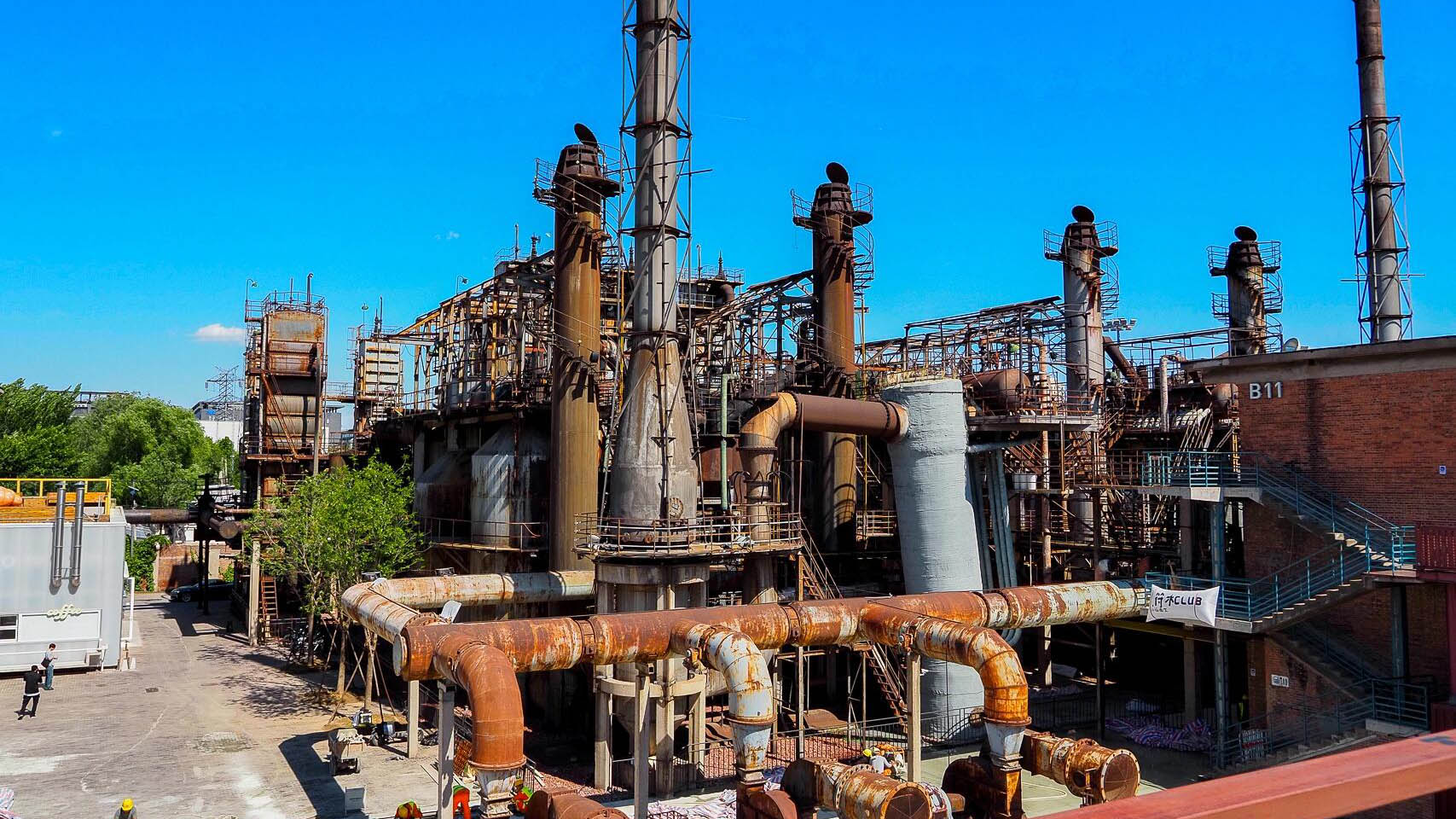
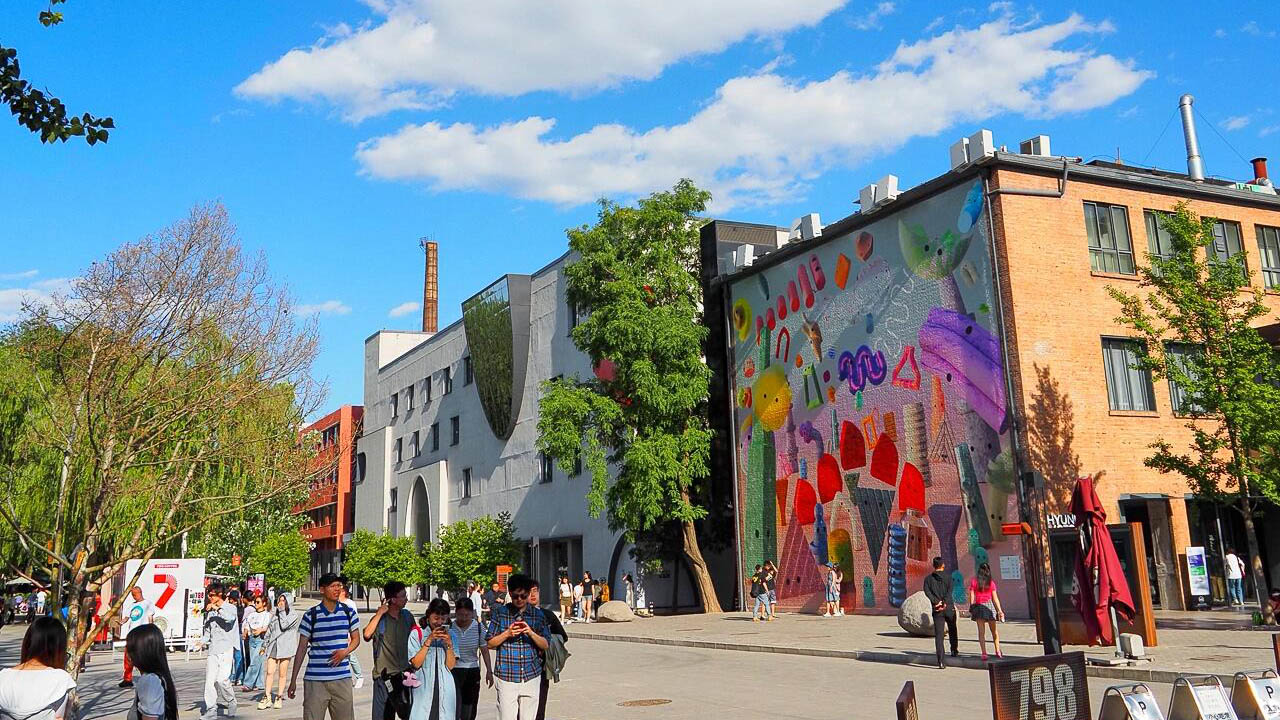
  • Dashanzi in Chaoyang District, Beijing's trendy art zone, this old warehouse and factory district has been taken over by art galleries, art shops and bars. Well worth the try.
Talk

The language of Beijing is Mandarin Chinese. Standard Mandarin itself was the administrative language of the Ming and Qing dynasties and was based mainly on the Beijing dialect. For language students this makes studying in Beijing an excellent chance to learn the language in a relatively pure form. That being said, Beijing dialect contains nasal "er" sounds at the end of many words. Hence the ubiquitous lamb kabobs (羊肉串 yáng ròu chuàn) become "yáng ròu chuànr". In addition, the Beijing dialect consists of many local slangs which have not been incorporated into standard Mandarin. Beijing taxi drivers are famously chatty and will gladly engage students of the language offering excellent chances to practice the language and get a feel for the changes in the city and country from an "Old Beijinger".

English is spoken by staff at the main tourist attractions, as well as at major hotels. Otherwise, English speakers are not common, so always get your hotel's business card to show the taxi driver in case you get lost. Likewise, have staff at your hotel write down the names of any tourist attraction you plan to visit in Chinese, so locals can point you out in the right direction.

Learn

There are countless universities in Beijing. The most famous ones are listed below and are some of the universities that offer classes to foreigners:

Foreign visitors were once restricted to staying in high-priced official hotels. Tour groups tend to use these hotels but do so at rates far below those published. In general, restrictions on where foreigners can stay have become less and less frequently enforced. Hostels and western-style travel hotels are almost universally open to foreign guests. The lowest end Chinese accommodations - Zhaodaisuo (招待所) - are generally inaccessible to the foreign community. However, for those determined to get a bargain, you may be able to get a room if you speak Chinese. Many of the hostels are located in Dongcheng District and Xuanwu District. Discounted rates start around ¥30 for dorms and just below ¥200 for doubles in the cheapest hostels.

There are a large number of three and four star mid-range hotels throughout the city and in all districts. The listed rates for these kind of hotels are often in the range of ¥500-1,000 but you can often get a discount of around 50%.

Some 'expensive' hotels are in the city centre, especially in Dongcheng District, and on the eastern 3rd Ring Road in Chaoyang District, however by Western standards these hotels are still relatively cheap. In the outlying areas, especially out by the Great Wall, are some country club type resorts as well as some unique, one-of-a-kind, hotels. For the most expensive hotels, the listed rates start at around ¥4,000, but are often discounted to a level around ¥1,500. There is also a "line" of budget hostel, south of Qian Men in Beijing/Chongwen, big street on right: Leo hostel, 365 Inn, split in 2 / take left, Jing Yi shi hostel, train booking office, street on the left to Leo courtyard, Far east hostel.

Stay Safe

Despite its size, Beijing is a very safe city, and violent crime is extremely rare. However, tourists are often preyed upon by cheats and touts, who attempt to pull a number of scams on tourists. Be especially cautious in the inner city, around Tiananmen Square, and on the tourist-crowded routes to the Great Wall.

On the other hand, fears of scams have led many travelers to be overly dismissive of Chinese people who approach them. Many Chinese are tourists in their capital for the first time as well and they are genuinely curious about foreigners and may just want to practice their English and get a picture with you. Being asked to have your picture taken is very common and there are no known scams associated with this. Be friendly but don't feel pressured to go somewhere you hadn't planned on going in the first place. If you are outside the tourist areas then your chances of being scammed drop dramatically.

Chinese people are very friendly to travelers and expats in general; seeing through a scam requires the same common sense as travelling anywhere in the world. Beijing scams are not particularly innovative or brutal in world-wide comparison, and as long as you keep your wallet out of sight, you can always walk away without fear of violence or theft. That said, there are some common scams to be aware of.

  • For tours to the Great Wall, be wary: the driver might just stop and set you off before your destination. Only pay afterwards if you are absolutely sure you are at the destination. Do not go for organized tours to the Great Wall in the ¥100-150 range that are advertised by people handing out flyers around the Forbidden City (or in the latest scam, masquerading as the real bus service to the Great Wall which only costs ¥20, but is guaranteed to waste your entire day). Conveniently you are picked up from your hotel (so they know where to get back at you, in case you will not pay), you end up on a shopping tour and afterwards you have to pay upfront to get back to the city. Of course, there are exceptions, and people showing letters of recommendation from their previous travels and pictures are usually ok, as are people offering trips to the wilder parts of the Great Wall (ie. not Badaling or Juyong). Shopping tours are also advertised from certain hotels, ask in advance for a tour without shopping to be sure.
  • At the Bird's Nest, there will be people trying to sell you small items, such as Beijing 2008 Memorabilia, or toys that seems fun to play with. They will tell you that they are offering it to you for much less, then after you pay for your item, shortly after they will claim you never paid for it and will follow you around until you either give back them or pay again. Usually they offer items to you at very good deals, but don't fall for the trick, you'll end up paying double, if not more.
  • Do not be tricked by students or young adults offering to go out for a beer or coffee to practice their English. Some scam artists will run up a elaborate bill by ordering food or alcohol and then expect you to pay for it or even half whether or not if you do or do not eat the food they order. In Chinese culture if someone invites you out for tea or dinner they pay the bill. If you are feeling this situation is about to happen shift credit cards out of your wallet by going to the bathroom or while sitting at the table. The scam artists can be working with the restaurant and the restaurant will ask you to pay with a credit card. Another sign if it is a scam is if they ask to follow you to a bank or back to your hotel to get additional money to pay them back. These people can come on very nice and come off as very nice people. If they want to follow you back to your hotel or hostel have them wait in the lobby and do not return. These people will likely avoid confrontation and eventually leave.
  • Do not follow any "students" or Chinese "tourists" wanting to show you something. They are most likely scammers or semi-scammers. Examples include "art students" who bring you to their "school exhibition" and pressure you to buy art at insanely inflated prices. Tea sampling is another scam. It is free to sample tea for locals, but for tourists...you should ask. Always get prices in advance and keep the menu if you are concerned. In one incident, after sampling 5 types of tea with two "students", a group of tourists were confronted with a bill for ¥1260! They even produced an English menu with the extortionate prices for sampling. Young attractive female "students" also try to lure male tourists to shops, restaurants or night clubs. The prices at such places can be extremely high for basically nothing."
  • In 2010 there were reports of aggression against people of foreign decent in Beijing from one club in particular, Latte. The US embassy released a note in 2010 advising citizens of the USA not to go there. There are few details of what happened there. Since then many travelers and local expats have frequented there without incidence. These seem to have been isolated occurrences.
  • Fake alcohol can sometimes be a problem, not frequently but sometimes. A good rule is that if it seems a lot cheaper than other places you've been than you might want to think hard about whether to take that 5RMB or 10RMB shot. It might be cheap for a reason. For information on which bars serve fake alcohol and which ones don't check any local review site. You can find these sites pretty easily they are just a search away.
  • Take care when offered a ride in a rickshaw (pedicab). Make sure you and your driver know where you are going to be taken in advance and agree on a price in writing. If not, you might get into an argument with the driver and end up paying a lot more than is fair. Rickshaw drivers generally charge ¥5 or ¥10 more than a taxi for short distances. It could be more for longer ones.

Be wary of fake money. You may observe Chinese people inspecting their money carefully, and with a reason: there are a lot of counterfeit bills in circulation. The most common are 100's and 50's. A few tips for identifying counterfeit bills:

  • Be very careful if someone wants to give back the largest currency bill (¥50 and ¥100) by the excuse of "no change". In an attempt to pass you a counterfeit bill they may tell you that they have lowered the price in your benefit. Or, they may ask you to contribute an additional sum in order to pass you the ¥100. If they give you back all the change money plus the coins on top (though coins are rare in Beijing) take your time to check each bill carefully.
  • Another version of the above trick is when a vendor refuses to accept your ¥100 bill claiming that it's fake. The truth is most likely that he took your genuine bill and discretely changed it for a fake one which he now is trying to give back to you. Hard to prove unless you saw the swap.
  • To check any ¥50 and ¥100 bill you get, do this: most importantly, check the paper. If its torn, thin or very slippery, ask for a different bill. Next, check the watermark, it should blur out softly. If there are hard visible corners in the watermark, reject the bill. Last, check the green "100" imprint on the lower left corner. It should be clearly painted on the bill so you can both feel and see a relief. If its missing or not feelable, reject the bill also. Rejecting bills is not considered impolite. It is perfectly acceptable to hand back a bill and ask for a different one. If the vendor gets upset, you should consider cancelling the purchase and moving on. If the colouring of a banknote is faded, it does not necessarily mean it is fake

Traffic can be crazy in Beijing, and reckless driving is fairly normal. People honk all the time. Honking is not usually considered rude. It is simply another way to indicate that the driver is there. Be prepared for drivers to violate traffic laws even to the extent of going in reverse on highways to back up to a missed exit or driving on a sidewalk. Also expect occasional road debris (a piece of wood or torn out tire) to be laying in the roadway. Pedestrians should be very careful crossing the street people will generally stop for you, but they will honk. Keep an eye on the locals and cross with them — there is strength in numbers.

Free emergency telephone numbers:

  • Police: 110.
  • Fire alarm: 119.
  • Medical care: 120

Remember these three telephone numbers, and they are valid in almost entire mainland China.

West China Go Travel Service info@westchinago.com Tel:86-13540893980 Fax:86-28-86614419
WestChinaGo.com Copyright@2010ICP09008864 All Rights Reserved